

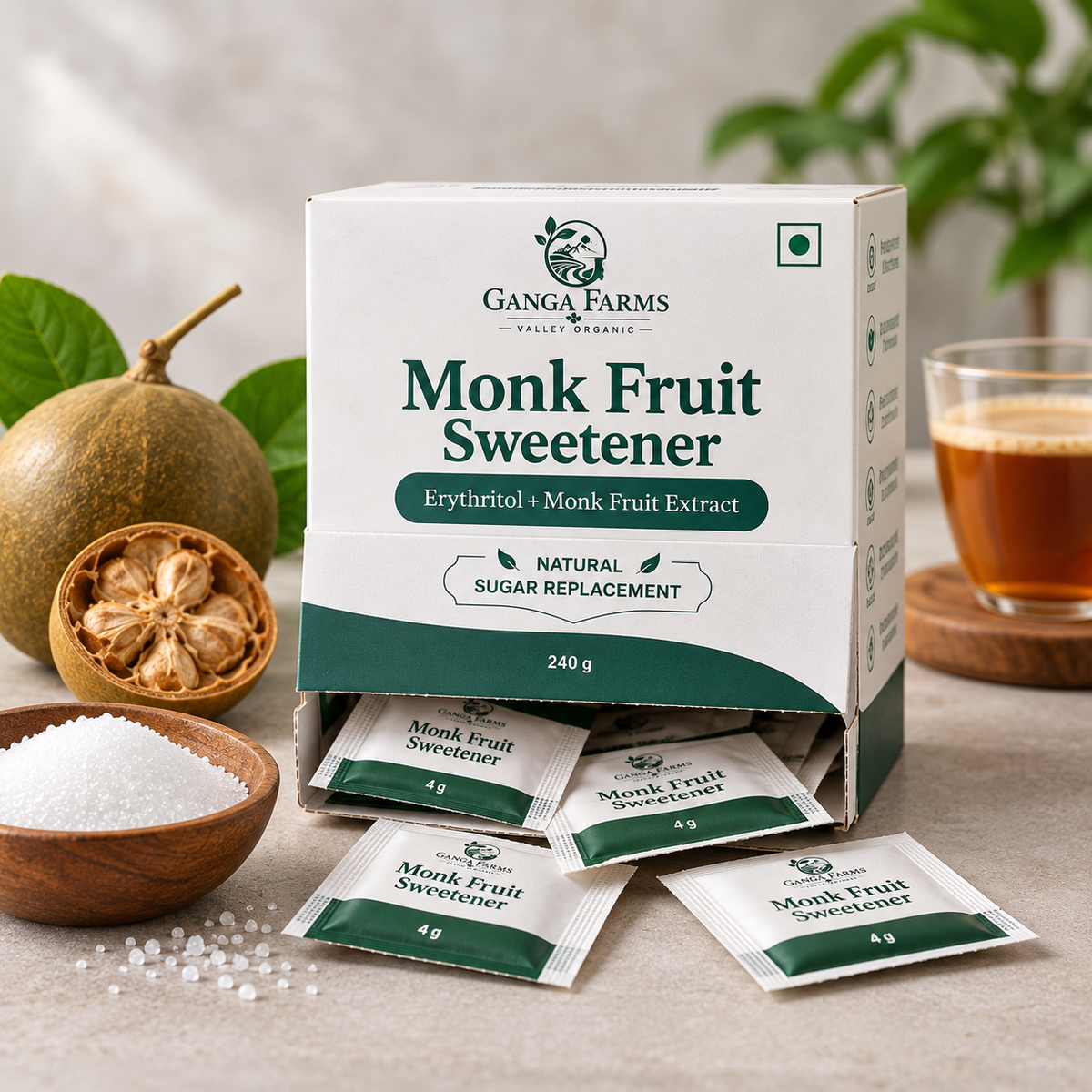
Ganga Farms Everyday Sweet | Monk Fruit Sweetener | Natural Sugar Replacement
Ganga Farms Everyday Sweet | Monk Fruit Sweetener | Natural Sugar Replacement
One sachet. One cup. Exactly like the sugar you are replacing, minus the sugar.
• A true 1:1 swap — one sachet sweetens a cup the way one sachet of sugar does. No measuring, no half-sachets, no guessing
• 60 sachets — two months of morning chai, where most sachet packs give you one
• Zero sugar, zero calories — 0 kcal and 0 g of sugar per 4 g sachet, straight off the panel
• Two ingredients — erythritol and monk fruit juice powder. Nothing else
• No bitter aftertaste — the erythritol base is what rounds off the sharp finish that puts people off pure extracts
• Made for handing round — pocket, handbag, office drawer, tea tray. A jar cannot do any of that
Couldn't load pickup availability
-
Ordered
- - -
Order Ready
- - -
Delivered

Ganga Farms Everyday Sweet | Monk Fruit Sweetener | Natural Sugar Replacement

What's Inside?
What's Inside?
60 sachets of 4 g each (Net Wt. 240 g). Each sachet is a blend of monk fruit juice powder and erythritol — nothing else, no fillers, no flavour.
Key Benefits
Key Benefits
Zero sugar and zero calories per 4 g sachet. A true 1:1 swap for a sachet of sugar, with a clean finish and none of the bitter aftertaste that puts people off sweeteners. Natural monk fruit and erythritol, no synthetic sweeteners.
How to Use
How to Use
In tea or coffee. One sachet per cup, exactly where the sugar sachet went. Stir as usual.
In nimbu pani, shakes and juices. One sachet per glass. Dissolves clean in cold liquid, no grit at the bottom.
In curd, oats and fruit. Tear one over the bowl the way you would sprinkle sugar.
In kheer, halwa and desserts. Add towards the end of cooking rather than the beginning, and taste as you go.
On the tea tray. Put a few in a dish beside the cups. Guests use them without needing an explanation.
A note on baking: sweetness swaps one for one, but sugar also does structural work in baking — browning, moisture, the way a cake sets. Results in a bake will not be identical to sugar.
Ingredients
Ingredients
Ingredients: Erythritol, Monk Fruit Juice Powder.
Contains erythritol. Polyols may have a laxative effect.
Nutrition (per sachet ≈ 4 g)
Nutrition (per sachet ≈ 4 g)
Energy: 0 kcal (0% RDA)
Total Fat: 0 g (0%)
Sodium: 0 mg (0%)
Carbohydrate: 3.95 g
Total Sugar: 0 g
Added Sugar: 0 g (0%)
Sugar Polyol: 3.95 g
Protein: 0 g (0%)
The carbohydrate figure and the polyol figure are the same number because the carbohydrate is the polyol. Erythritol is a sugar alcohol, not a sugar.
Storage
Storage
Store in a cool, dry place. Keep away from moisture — erythritol draws in damp and will clump.
Keep sachets sealed until use.
Keep out of reach of children.
Caution
Caution
Contains erythritol. Polyols may have a laxative effect.
Not for medicinal use. This health supplement is not a substitute for a varied diet and is not intended to diagnose, treat, cure or prevent any disease.
Pregnant or lactating women, and people with known medical conditions, should consult a qualified healthcare professional before consuming.
Keep out of reach of children.
Shipping & Returns
Shipping & Returns
Free shipping above ₹999. Delivered in 2–5 business days across India. Returns accepted on unopened products only.
🍃 Zero Sugar · Zero Calories
✦ 10% OFF ON ALL ORDERS
🍃 Zero Sugar · Zero Calories
✦ 10% OFF ON ALL ORDERS
🍃 Zero Sugar · Zero Calories
✦ 10% OFF ON ALL ORDERS
🍃 Zero Sugar · Zero Calories
✦ 10% OFF ON ALL ORDERS
🍃 Zero Sugar · Zero Calories
✦ 10% OFF ON ALL ORDERS
🍃 Zero Sugar · Zero Calories
✦ 10% OFF ON ALL ORDERS
What Makes Everyday Sweet Different?
Two ingredients, one sachet, and a ratio that finally matches your sugar.


The Immortals' Fruit
Monk fruit is not a laboratory invention with a botanical name attached for reassurance. It has a real history, and it is worth knowing.
Named for the monks who grew it. Luo Han Guo means "arhat fruit" — after the Buddhist monks of the Guangxi mountains who have cultivated it since at least the thirteenth century.
The Immortals' Fruit. The villages that grew it were noted for unusual longevity, and the fruit picked up the nickname. Folklore rather than evidence — but it is why the plant was preserved for seven hundred years.
Sweetness without sugar, naturally. Monk fruit's sweetness comes from mogrosides, natural compounds that are intensely sweet while carrying no sugar at all.
Still grown where it started. The commercial crop remains concentrated in the same subtropical mountain valleys of southern China.
Our Bestsellers
Discover our most popular organic products

Ganga Farms Sea Buckthorn Powder | Wild-Harvested from High-Altitude Ladakh

Ganga Farms Sun-Dried Sea Buckthorn Berries The Whole Wild Superfruit from Ladakh

Ganga Farms Pure Moringa Powder | Shade-Dried for Maximum Nutrition

Why Thousands Trust Ganga Farms
-

100% Natural
No chemicals, additives or preservatives — ever.
-

Lab Tested
Every batch tested for purity and potency before dispatch.
-

Secure Checkout
Your payment and personal data are fully protected with every order.


Frequently Asked Questions
Can't find the answer you're looking for? We're here to help.
One sachet replaces one sachet of sugar. That is the whole design. No measuring, no halving, no conversion table.
A small round gourd, Luo Han Guo, grown in the mountains of southern China for centuries. Its sweetness comes from natural compounds called mogrosides which are intensely sweet but contain no sugar.
Because pure monk fruit extract is hundreds of times sweeter than sugar, so a usable sachet of it would be a few grains. It also finishes thin and slightly sharp on its own. Erythritol gives the blend its body, its volume and its clean finish — it is the reason this measures and tastes like sugar rather than like a substitute.
This is the complaint that has damaged the whole category, and it usually comes from pure high-intensity extracts used alone. The erythritol base is specifically what removes that finish. Most people find this blend tastes clean, with a very slight cooling sensation on the tongue that comes from the erythritol.
Erythritol is a sugar alcohol found naturally in fruit such as pears, grapes and melons, and it has been in use as a food ingredient for decades. It is approved for use in India and internationally. It is also, like all polyols, not fully absorbed — which is why it carries no calories, and also why large quantities can cause a laxative effect. That warning is printed on our pack. If you have seen recent headlines about erythritol and heart health, those come from observational research measuring erythritol levels in blood rather than trials of dietary intake, and the science is still being debated. We have printed what is in the pack so you can decide for yourself, and anyone with a specific health concern should speak to their doctor.
The panel shows zero sugar and zero calories per sachet. We are not able to make claims about blood glucose or any medical condition, and we would not want to. If you are managing a health condition, please speak to your doctor about whether this product suits you.
Because the carbohydrate is the polyol. Erythritol is classified as a carbohydrate but it is a sugar alcohol, not a sugar — which is why the sugar row reads zero and the polyol row carries the same 3.95 g. Both figures are there so you can see exactly what is happening.
You can, with one caveat. The sweetness swaps one for one, but sugar also does structural work in baking — browning, moisture retention, texture. Cakes and biscuits will not come out identical. For tea, coffee, cold drinks, curd, fruit and stovetop desserts like kheer or halwa, the swap is straightforward.
Both are natural, both are non-sugar sweeteners, and both are usually blended with erythritol. The practical difference is taste: stevia has a distinct liquorice-like note that a lot of people notice and some dislike, while monk fruit is generally described as closer to plain sweetness. Which you prefer is genuinely personal.
At one cup of tea a day, two months. For a two-person household at one cup each, about a month.
Yes. It dissolves clean in nimbu pani, shakes and cold coffee without leaving grit at the bottom. Stir for a few seconds longer than you would in a hot cup.
Yes. Both ingredients are plant-derived — monk fruit from the fruit itself, erythritol by fermentation. Nothing in it is of animal origin.